

Zlatin Pavlov
Hello, my name is Zlatin Pavlov, and I am the creator of LanguageNest.
I would like to tell you a little more about myself and about the journey that connected me with China, the Chinese language, and Chinese culture.
My interest in China began at a very young age. From childhood, I was strongly drawn to Chinese culture and traditional Chinese martial arts. At the age of seven, I began training in Chinese Wushu (武术), and later I also practiced Taijiquan (太极拳).
Let me tell you a bit more for me:
My First Experience in China and with the Chinese Language
In 2016, I had my first opportunity to travel to China, where I spent six months taking part in a training program focused on Chinese martial arts.
At that time, I did not speak Chinese and had very little idea of what to expect from life in China. After my arrival, the program also included evening Chinese language classes for beginners, held for several hours each week. This was my first real introduction to the language.
At first, Chinese seemed almost impossible to learn. The characters looked more like unfamiliar drawings than a writing system, and the language itself felt completely different from anything I had encountered before.
Over time, however, thanks to the classes and my constant efforts to use what I had learned in everyday situations, I began to realize that Chinese was not as inaccessible as it first appeared. Gradually, I started to understand its logic, structure, and beauty.
At the end of my stay in China, I took the HSK examination for the first time – the standardized Chinese language proficiency test. Although this was only the beginning of my language-learning journey, I successfully achieved HSK Level 2.
After returning to Bulgaria, I was certain of one thing – China was where I wanted to continue my education and pursue my professional development.
Education in China
-
Beijing Normal University
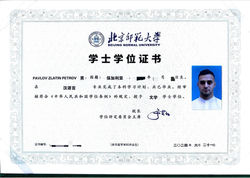
In 2018, I applied for higher education in China and was accepted to Beijing Normal University (北京师范大学) in Beijing, where I began my studies in a program related to Chinese language and pedagogy.
Because my Chinese language level at the time was not yet sufficient for full-time academic study entirely in Chinese, I first completed an intensive one-year language preparation program.
-
Beijing International Studies University
I completed my language preparation at Beijing International Studies University (北京第二外国语学院).
This was an extremely important stage in my language development. The program was intensive and focused on improving all aspects of Chinese – grammar, listening, reading, writing, and spoken communication.
After successfully completing the language program, I achieved HSK Level 4, which allowed me to continue with my bachelor's degree studies.
-
Bachelor's Degree and HSK Level 6
Over the following years, I continued to improve my Chinese both in an academic environment and through its daily use.
Living and studying in China gave me the opportunity not only to develop my language skills, but also to gain a much deeper understanding of Chinese culture, society, ways of thinking, and everyday life.
By the time I completed my bachelor's degree, I had successfully achieved HSK Level 6 – the highest level in the HSK system at the time I took the examination.
-
Shanghai University of Finance and Economics
After completing my bachelor's degree, I continued my academic journey in Shanghai, where I was admitted to Shanghai University of Finance and Economics (上海财经大学).
There, I pursued a master's degree in International Business, which I successfully completed.
My master's studies gave me the opportunity to build upon the knowledge and practical experience I had already gained and to continue developing academically and professionally in an international environment.
Seven Years of Living and Studying in China
What began as a six-month stay in China, inspired by my interest in Chinese martial arts and my first Chinese language classes, gradually became seven years of living, studying, and developing in China.
During this period, I had the opportunity not only to complete my higher education, but also to use Chinese every day – at university, in social settings, and in real-life situations.
This long-term personal and academic experience is at the heart of the way I teach Chinese today.
Why I Created LanguageNest
From my own experience, I know how unfamiliar and difficult Chinese can seem at the very beginning.
I still remember my first encounters with Chinese characters, when they looked like complex drawings with no obvious logic, and the feeling that such a different language might be almost impossible to master.
Over time, however, I discovered that when Chinese is presented in a clear, structured, and accessible way, it can become far more logical, understandable, and engaging than it initially appears.
This idea is at the heart of LanguageNest.
I created LanguageNest with the goal of making Chinese language learning more accessible, structured, interactive, and practically oriented.
For me, learning Chinese should not be limited to memorizing vocabulary, characters, and grammar rules. The goal is for students to gradually understand how the language works, recognize its logic, and most importantly, gain the confidence to use it in real-life situations.
That is why, through LanguageNest, I aim to combine traditional language learning with interactive exercises, listening comprehension, practical tasks, grammar resources, HSK preparation, and materials specifically designed around learners' needs.
My Approach to Teaching
I believe that every student has a different pace, different goals, and a different way of learning.
For this reason, I aim to adapt the learning process to the individual rather than expecting every student to follow exactly the same path.
In my teaching, I place particular emphasis on:
-
understanding the logic of the Chinese language;
-
correct pronunciation and tones;
-
gradual and systematic learning of Chinese characters;
-
grammar explained in a clear and practical way;
-
listening and speaking in real-life situations;
-
building confidence in using the language;
-
preparation for HSK examinations;
-
the use of interactive materials and practical exercises.
My goal is for students not to learn Chinese mechanically, but to understand how and why particular words, structures, and grammar patterns are used, and gradually become able to use the language naturally and confidently.
Education and Qualifications
Beijing Normal University (北京师范大学)
Bachelor's studies – Chinese language with a pedagogical focus
Beijing International Studies University (北京第二外国语学院)
Intensive one-year Chinese language preparation program
Shanghai University of Finance and Economics (上海财经大学)
Master's Degree – International Business
HSK Level 6
The highest level in the HSK system at the time the examination was taken
Seven years of living and studying in China
LanguageNest
LanguageNest is the result of this entire journey – from my very first Chinese lesson to the years I spent studying and living in China.
My goal is to use the knowledge, practical experience, and understanding of the Chinese language and culture that I have gained over the years to help more people discover Chinese in a more accessible, engaging, and modern way.
Whether the goal is to start learning Chinese from the very beginning, prepare for the HSK examination, improve conversational skills, prepare for studying in China, or develop a deeper understanding of Chinese culture, LanguageNest is designed as a place where every learner can build their knowledge and skills gradually, confidently, and with a clear sense of direction.
 |  |  |  |
|---|---|---|---|
 |  |  |  |